

How does a Stitchwelder compare with spot welders?
Dec 03, 2025
Hey there! As a supplier of Stitchwelders, I often get asked how these machines stack up against spot welders. So, I thought I'd dive into the details and give you a real - world comparison.
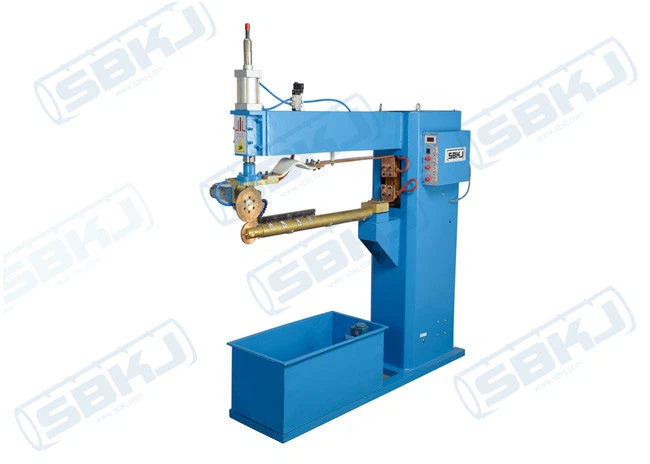
Let's start with the basics. A Stitchwelder is a type of welding machine that creates a series of overlapping welds, forming a continuous or semi - continuous seam. On the other hand, a Spotwelder makes individual, discrete welds at specific points.
Weld Quality
When it comes to weld quality, both machines have their strengths. Spot welders are great for creating strong, localized joints. They concentrate a high amount of energy at a single point, which results in a very solid connection. This is especially useful when you're working with materials that need to withstand high stress in specific areas. For example, in automotive manufacturing, spot welds are used to join body panels together because they can handle the mechanical forces during driving.
However, Stitchwelders offer a different kind of quality. The overlapping welds create a more continuous bond, which can be better for applications where you need to prevent leaks. Take the Production Of Round Hvac Air Pipe Seaming Welding Air Duct Machine for instance. In HVAC systems, air ducts need to be airtight to ensure efficient airflow. A Stitchwelder can create a seamless weld that minimizes air leakage, which is crucial for energy efficiency.
Speed of Welding
Speed is another important factor to consider. Spot welders are generally very fast at creating individual welds. Since they only need to focus on a single point at a time, they can quickly move from one spot to the next. This makes them ideal for mass - production scenarios where you need to weld a large number of parts in a short amount of time. For example, in the production of metal furniture frames, spot welders can rapidly join the different pieces together.
Stitchwelders, while not as fast as spot welders on a per - weld basis, can be more efficient for continuous welding tasks. When you're working on a long seam, a Stitchwelder can keep moving along the joint, creating a continuous weld without having to stop and start for each individual spot. This can save time overall, especially when welding large sheets or pipes.
Cost
Cost is always a concern for any business. Spot welders tend to be more affordable upfront. They are simpler in design and require less complex control systems compared to Stitchwelders. This makes them a popular choice for small - scale operations or those on a tight budget.
But we also need to consider the long - term costs. Stitchwelders may have a higher initial investment, but they can save you money in the long run. The continuous welds they create can reduce the need for additional sealing or finishing processes. For example, in the HVAC industry, a well - stitched air duct may not require extra gaskets or sealants to prevent air leakage, which can cut down on material and labor costs.

Flexibility
In terms of flexibility, spot welders are highly adaptable. They can be used on a wide variety of materials, including different types of metals and thicknesses. You can easily adjust the welding parameters to suit the specific requirements of each job. This makes them a versatile tool in many workshops.
Stitchwelders, however, are more specialized. They are designed mainly for creating continuous seams, so their application is more limited in terms of the type of welding they can perform. But if your business focuses on tasks like welding pipes or sheets where continuous seams are required, a Stitchwelder is the way to go.
Maintenance
Maintenance is an aspect that often gets overlooked but is crucial for the longevity of your equipment. Spot welders are relatively easy to maintain. They have fewer moving parts compared to Stitchwelders, which means there are fewer components that can break down. Regular cleaning and electrode replacement are usually the main maintenance tasks.
Stitchwelders, due to their more complex design, may require more in - depth maintenance. The rollers and guides that help create the continuous weld need to be properly aligned and lubricated. However, with proper care, a Stitchwelder can last a long time and provide consistent performance.
Safety
Safety is paramount in any welding operation. Both spot welders and Stitchwelders have their own safety considerations. Spot welders generate a lot of heat and light at the welding point, which can cause eye damage if proper protection isn't worn. They also produce sparks, so a fire - safe work environment is essential.
Stitchwelders, while also generating heat and light, may have additional safety concerns related to their continuous operation. The moving parts and the long - term exposure to the welding process require operators to be more vigilant. But modern Stitchwelders are equipped with safety features like emergency stop buttons and protective shields to minimize risks.
So, which one is right for you? Well, it really depends on your specific needs. If you're in an industry that requires strong, discrete joints and high - speed production, a spot welder might be the better choice. But if you need to create continuous, leak - proof seams, especially for applications like HVAC air ducts, then a Stitchwelder is worth considering.
If you're interested in learning more about our Stitchwelders or want to discuss which welding machine is best for your business, don't hesitate to reach out. We're here to help you make the right decision and ensure that you get the most out of your welding equipment. Let's have a chat and see how we can meet your welding needs!
References
- Welding Handbook, American Welding Society
- Metal Fabrication Technology Magazine, various issues